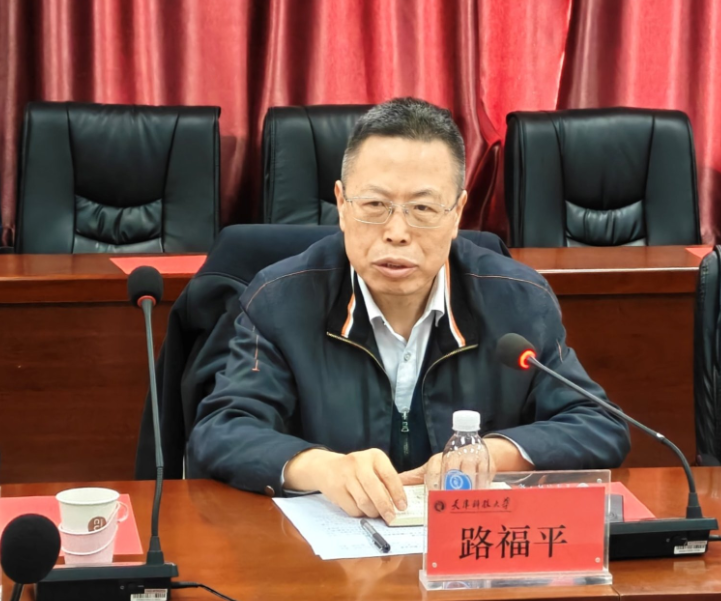
On March 22, the K11 Special Seminar on 'Precision Nutrition and Intelligent Food Manufacturing' at Tianjin University of Science and Technology was successfully held in Room 337 of the Yifu Building on the Binhai Campus. Lu Fuping, Deputy Secretary of the Party Committee and President of the university, attended the meeting and delivered a speech. Leaders and key personnel from the Graduate School, School of Food Science and Engineering, School of Mechanical Engineering, School of Electronic Information and Automation, School of Artificial Intelligence, School of Light Industry Science and Engineering, School of Chemical Engineering and Materials, and School of Science, along with some research backbones and teacher representatives, participated in the seminar.
The seminar closely focused on the university's core tasks under the '15th Five-Year Plan,' based on the cutting-edge development direction and industry needs of the food discipline. Its core goals were to tackle the bottlenecks in interdisciplinary intgration, build a platform for cross-disciplinary collaborative innovation, and explore new paths for interdisciplinary development. Several thematic reports and in-depth discussions were held.
In his speech, Lu Fuping pointed out that interdisciplinary integration is the only way to overcome industrial technology bottlenecks, produce high-level landmark achievements, and enhance core competitiveness in disciplines. He emphasized empowering traditional local industries with advanced productivity; promoting interdisciplinary integration, highlighting discipline characteristics and differentiated development to form a sustainable innovation path; engaging deeply with enterprises to build an innovation consortium and ensure scientific research is practical and implemented; strengthening international cooperation to actively learn and absorb advanced foreign technologies, breaking through high-end foreign technology bottlenecks; and implementing the mentorship system effectively, actively changing teaching and talent cultivation methods, and optimizing graduate research topics with commercialization and disciplinary contribution as goals.
At the meeting, the main leaders of the School of Food Science and Engineering provided a systematic introduction to the construction background, direction, and content of the 'Food Intelligent Manufacturing Engineering Discipline Interdisciplinary Center,' and clarified the center's goals for the next five years.
During the main presentation session, Professor Chen Ye, Professor Wu Tao, Researcher Liu Xia, and Associate Professor Geng Weitao from the School of Food Science and Engineering gave reports on four core topics: interdisciplinary approaches to tackling food engineering (mechanical) problems, the integration path between precision nutrition and artificial intelligence, interdisciplinary approaches for quality assurance, and interdisciplinary paths for future food development. They showcased their teams’ research achievements in these areas and proposed research directions for interdisciplinary integration.
In the in-depth discussion session, responsible representatives from the School of Mechanical Engineering, School of Electronics, Information and Automation, School of Artificial Intelligence, School of Light Industry Science and Engineering, School of Chemical Engineering and Materials, and School of Science each introduced their research directions and projects. They exchanged and discussed opportunities and directions for interdisciplinary integration, focusing on automation control, high-fidelity model establishment, digital twin technology development, process and new material development, and food packaging and food equipment development.
This seminar further clarified the construction direction for 'precision nutrition and food intelligent manufacturing,' established a regular campus platform for multidisciplinary collaborative innovation exchanges, and gathered a strong collaborative force for interdisciplinary development, laying a solid foundation for the high-quality construction and implementation of subsequent innovation consortia.